
Quick answer: Because honeybees are important pollinators, live hive relocation is the preferred removal method wherever the nest location allows it, rather than extermination
Honeybees typically nest in wall voids, chimneys, and hollow trees, building wax comb that grows week over week if left in place. Bumblebees, by contrast, usually nest in small ground burrows or under sheds and are far less aggressive.
Because honeybees are pollinators, we prioritize live relocation over extermination wherever the hive location allows it, and we remove old comb after relocation so the wax and honey don’t attract secondary pests.
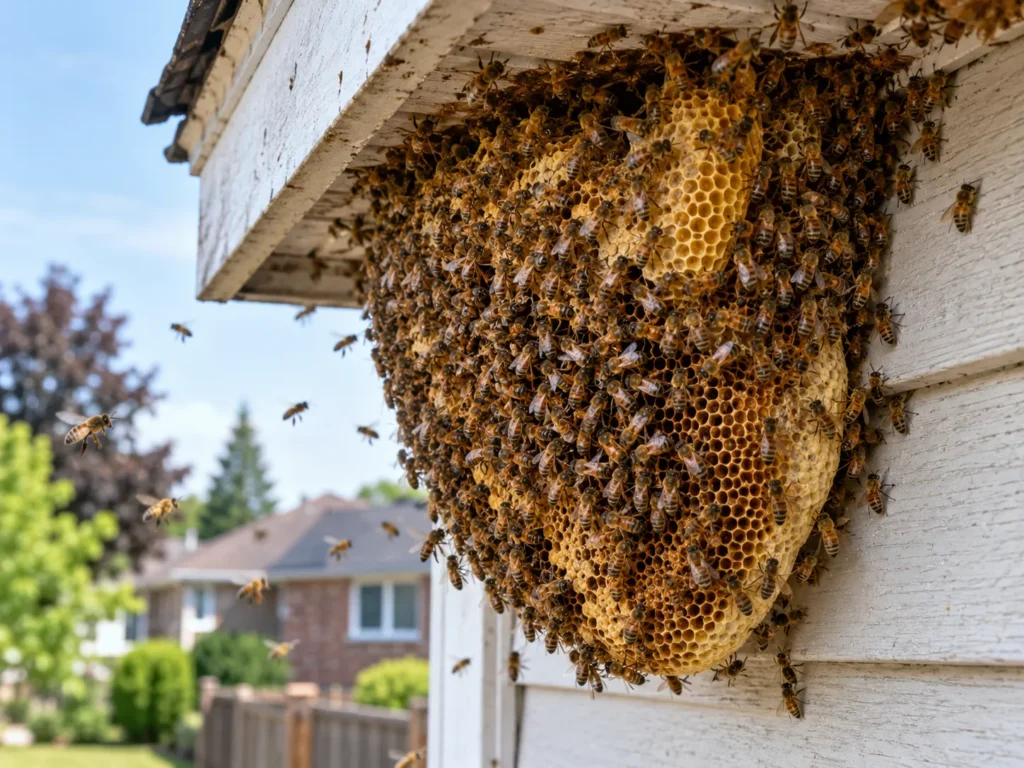
We identify the species and nest location first, since the removal method differs by species and by whether the hive is exposed or inside a wall cavity. For wall cavities we open the void, remove comb, and seal it to prevent a repeat colony.
Full service area: Ajax · Aurora · Bradford · Brampton · Bowmanville · Clarington · Courtice · Durham · East Gwillimbury · East York · Etobicoke · Georgina · Keswick · King City · Maple · Markham · Mississauga · Mount Albert · Newcastle · Newmarket · Nobleton · North York · Oshawa · Pickering · Port Perry · Richmond Hill · Scarborough · Scugog · Stouffville · Thornhill · Toronto · Toronto Beaches · Uxbridge · Vaughan · Whitby · Woodbridge · York Region
We prioritize live relocation for honeybee colonies wherever the hive location allows it, since they're important pollinators — extermination is a last resort.
Bees are fuzzy and typically less aggressive unless the hive is disturbed, while wasps are smooth-bodied and more likely to sting without provocation.
We don't recommend it — opening a wall void without proper protection risks stings and often leaves comb and honey behind, which attracts secondary pests.
Quality Pest Control GTA © 2026. All Rights Reserved.
