
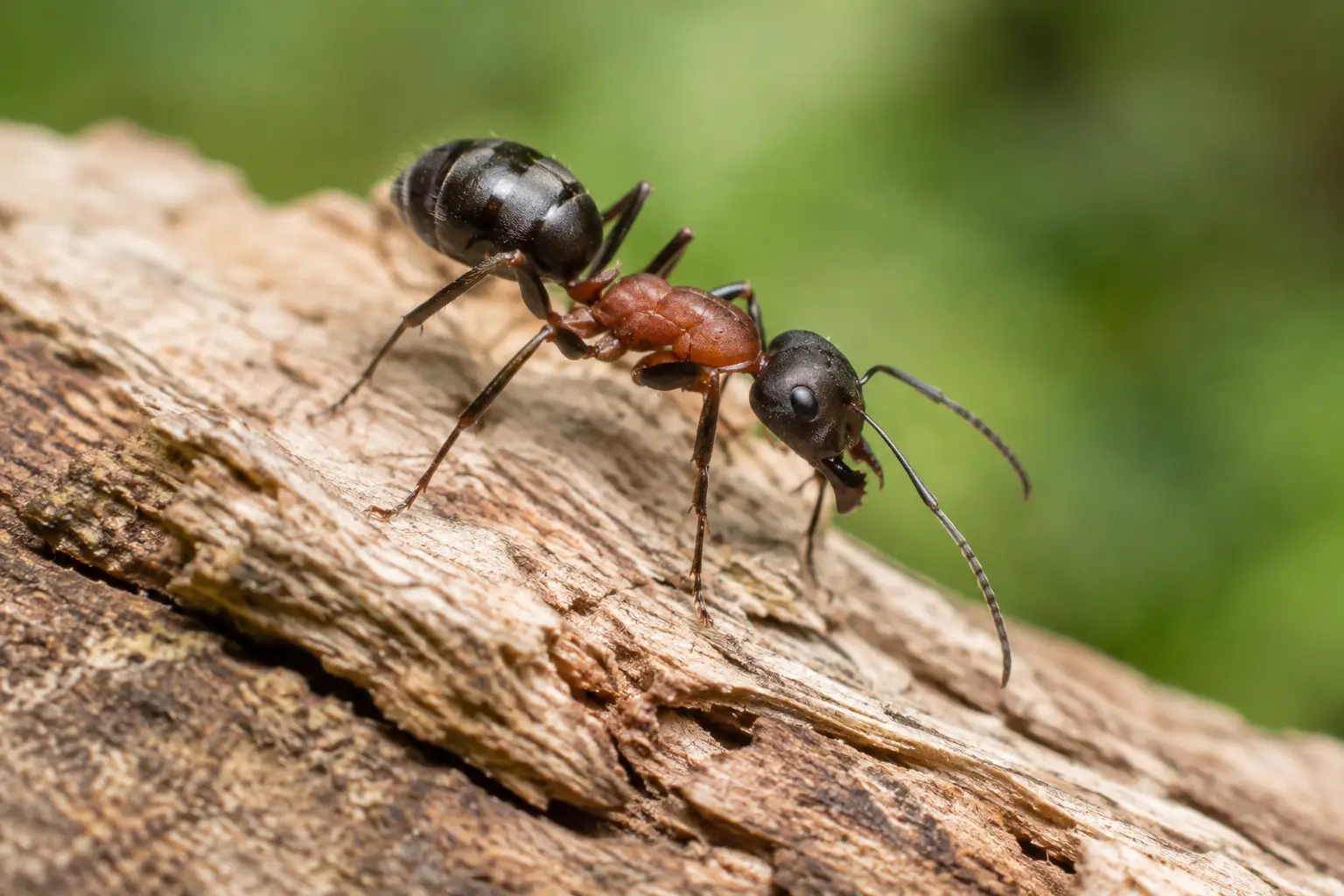
A few large black ants near a window can be easy to dismiss, especially in spring. But carpenter ant identification matters because these insects do more than search for food. They can establish nests inside damp, damaged, or vulnerable wood and gradually expand through a home, garage, shed, or commercial property.
Carpenter ants do not eat wood like termites. They excavate it to create smooth tunnels for their colonies. That distinction does not make them harmless. Left untreated, an active carpenter ant infestation can contribute to costly damage, particularly where moisture problems have already weakened framing, trim, decks, window sills, or structural beams.
What Does a Carpenter Ant Look Like?
Carpenter ants are among the largest ants homeowners commonly see in Ontario. Workers typically measure about one-quarter to one-half inch long, although size can vary within the same colony. Most are black, but some may appear dark brown, reddish-black, or a combination of dark red and black.
Their size alone is a useful clue, but it is not enough for a reliable identification. Look closely at the body shape. Carpenter ants have a rounded, evenly curved thorax, the middle section behind the head. Their antennae are bent at an elbow, and their waist has one distinct node between the thorax and abdomen.
The most common species found around GTA properties is often black or very dark, with a shiny appearance. Workers are active, fast-moving, and frequently travel alone rather than in a dense trail. Seeing one large ant indoors does not always mean there is a nest inside. Seeing several large ants repeatedly, especially overnight or near a moisture-damaged area, deserves attention.
Carpenter Ants vs. Termites
People often confuse carpenter ants with termites because both can be connected to wood damage. The insects look very different once you know what to check.
Carpenter ants have pinched waists, elbowed antennae, and uneven wing sizes on reproductive swarmers. Their front wings are longer than their rear wings. Termites have broad waists, straight antennae, and four wings that are roughly equal in length.
Their damage also differs. Carpenter ants create clean, smooth galleries in wood and push debris out of their nesting areas. Termites consume the wood itself and may leave mud tubes or earth-colored material around damaged sections. Either pest warrants professional inspection because guessing can delay the right treatment.
Carpenter Ants vs. Other Large Ants
Pavement ants, odorous house ants, and other nuisance ants may enter kitchens, bathrooms, and break rooms, but they are generally much smaller than carpenter ants. Carpenter ants are more likely to be noticed around wet wood, trees, stumps, rooflines, decks, and exterior walls.
A large flying ant can also cause concern during spring or early summer. Winged carpenter ants are reproductive ants that leave an established colony to start new nests. One flying ant may have come in from outdoors. Multiple winged ants emerging inside a home, however, can indicate an indoor nest and should be inspected quickly.
Signs That Support Carpenter Ant Identification
The ants themselves are only part of the picture. A professional assessment considers activity patterns, building conditions, and physical evidence around the property.
One of the clearest signs is frass. This is the sawdust-like material carpenter ants remove as they excavate wood. It may contain fine wood shavings, dead insects, and small fragments of insulation. Frass can collect below baseboards, beneath window frames, near door casings, in attic spaces, or under damaged deck boards.
You may also hear a faint rustling sound within a wall or hollow wooden feature when the building is quiet. This is not always noticeable, and it is not proof by itself, but it can support other signs of activity.
Watch for carpenter ants in these situations:
- Large black or reddish-black ants appearing regularly inside, especially at night
- Sawdust-like debris below wood trim, window frames, or wall voids
- Winged ants indoors during spring or early summer
- Soft, water-damaged, blistered, or hollow-sounding wood
- Ant activity near plumbing leaks, roof leaks, gutters, decks, tree stumps, or firewood
Carpenter ants are strongly attracted to moisture-compromised wood. A colony may nest in a rotting window frame, but forage in the kitchen for sweets, grease, pet food, or crumbs. This is why the place where ants are seen is not always the actual nesting location.
Where Carpenter Ants Nest Around Homes and Businesses
Carpenter ants can build satellite nests in a structure while maintaining a main nest outdoors. Mature colonies may use several nesting sites, making a quick spray around visible ants an unreliable solution.
Outside, common nest locations include tree stumps, fallen logs, landscape timbers, railroad ties, old fencing, woodpiles, and damaged decks. Trees with dead limbs or moisture damage can also support a colony close to the building.
Inside, they commonly target wall voids near leaks, attic framing affected by roof moisture, crawl spaces, bathroom walls, kitchen areas around plumbing, garages, and areas where wood contacts soil. Commercial properties can experience the same issue around roof drains, utility rooms, loading areas, planters, and poorly sealed exterior openings.
For homeowners in Toronto, Scarborough, Etobicoke, Pickering, Whitby, Oshawa, and nearby communities, spring moisture and seasonal temperature changes can make hidden wood damage easier for carpenter ants to exploit. Early action protects both the building and the people using it.
Why DIY Treatment Often Misses the Colony
Store-bought ant sprays may kill the workers you can see, but they usually do not reach the queen, nesting chambers, or satellite colonies. In some cases, disturbing ants with repeated surface treatments can cause them to relocate deeper into wall voids or spread activity to another section of the property.
Bait can be useful in the right situation, but carpenter ant feeding preferences can change. They may seek sweet foods at one time and protein or grease-based foods at another. The wrong bait, poor placement, or treating too soon around bait stations can reduce results.
The best approach depends on whether the colony is indoors, outdoors, or using both areas. It also depends on moisture conditions, construction materials, the extent of activity, and whether children, pets, tenants, or customers are present. A licensed pest professional can identify likely travel routes, inspect vulnerable areas, and select targeted treatment methods designed to eliminate the source rather than just suppress visible activity.
Professional Carpenter Ant Treatment
Effective carpenter ant control begins with inspection. A technician looks for ant activity, frass, moisture-damaged wood, entry points, exterior nesting conditions, and signs of satellite colonies. If conditions point to a hidden nest, the treatment plan may include targeted applications to active areas, exterior barriers, crack-and-crevice treatment, and recommendations for repairs that reduce future nesting opportunities.
At Quality Pest Control GTA, licensed technicians focus on safe, effective, and eco-friendly solutions whenever appropriate. Treatment is tailored to the property instead of relying on a one-size-fits-all spray. For rental units, condominiums, restaurants, offices, and other commercial spaces, a clear plan also helps address tenant concerns and protect daily operations.
Wood repairs and moisture correction are often part of long-term prevention. Pest treatment can remove the infestation, but a recurring leak, clogged gutter, or decaying exterior trim can continue to create ideal conditions for future activity.
Prevention Steps That Make a Real Difference
Carpenter ants need access, shelter, and favorable nesting material. Reducing those conditions around the building is one of the strongest ways to prevent a repeat problem.
Keep firewood, lumber, and yard debris away from exterior walls. Trim branches and shrubs so they do not touch the roof, siding, or windows. Repair leaking pipes, roof issues, damaged caulking, and loose or rotted trim as soon as possible. Clean gutters so water drains away from the foundation, and avoid letting mulch or soil sit against wood siding.
Inside, store food in sealed containers, clean up spills promptly, and do not leave pet food out overnight if ants have been active. These steps will not remove an established colony on their own, but they can reduce foraging and make your property less attractive after treatment.
Frequently Asked Questions
Are carpenter ants dangerous?
Carpenter ants are not usually dangerous to people. They can bite if handled, but their primary concern is property damage. Because they tunnel through wood, ongoing activity in damp or structurally vulnerable areas should be addressed promptly.
How do I know if carpenter ants are inside my walls?
Repeated sightings of large ants indoors, frass below trim or wall openings, winged ants emerging indoors, and activity near moisture damage are strong warning signs. Only an inspection can confirm the nest location with confidence.
Do carpenter ants go away in winter?
Outdoor activity declines in cold weather, but colonies nesting inside heated wall voids or other protected areas may remain active. A lack of visible ants in winter does not always mean the infestation is gone.
Should I remove a carpenter ant nest myself?
Removing an accessible outdoor nest may reduce activity, but hidden nests and satellite colonies are easy to miss. If ants are entering the building or wood damage is suspected, professional treatment is the more reliable option.
If you are finding large ants, sawdust-like debris, or signs of moisture-damaged wood, do not wait for the problem to become harder to control. A timely inspection can identify the source, protect the structure, and give you a clear path back to a pest-free property.

